

Preface: Recently, many cost-effective Wi-Fi 7 routers have been released, sparking a lot of debate online around this topic:
“WiFi6 is enough," "WiFi 7 is the future I really enjoy using it!" "It just increases power consumption, and my perception is weak!" "Whatever, I can't even run all 200m broadband WiFi 5!" ”。
These arguments seem to serve as formulaic templates in any technological iteration (good kids, don't try to learn them!). )。
Today, let's analyze what WiFi 7 means for us. This article will focus on the experience improvements brought by new technologies and provide a brief technical analysis.
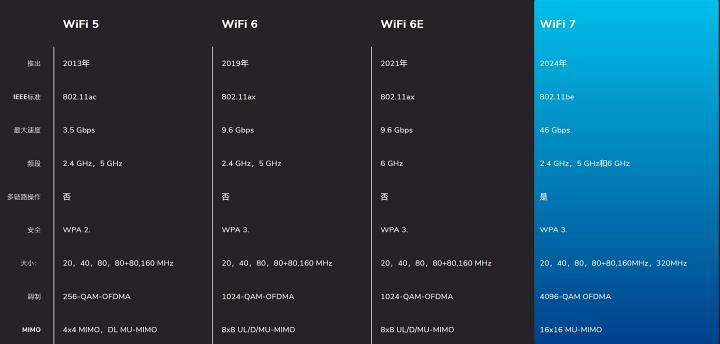
A horizontal comparison of the theoretical performance of several generations of WiFi standards
Summary of the article:
1. New features of WiFi 7 include: 6GHz, 320MHz bandwidth, 4096-QAM, Multi-RU, multi-link operation, multi-AP collaboration, and support for up to 16 maximum spatial streams.
2. WiFi 7 currently offers significant new features (6GHz, 320MHz bandwidth), but for some reasons, it is currently unavailable domestically
3. Some new features with certain improvements have already been implemented in some high-end WIFI6 products (4K QAM).
4. Some new features with significant improvements (multi-link aggregation, channel punching, support for 16 spatial streams), but the transceiver end has a "top-heavy" issue. The transmitter follows up quickly, but the receiver has many support issues!
Main Text:
1. A brief interpretation of the WiFi 7 standard—"Know what it is, and why it is"
What is WiFi 7?
WiFi7 corresponds to the IEEE 802.11be EHT standard, which stands for Extremely High Throughput. From the name, it's clear that this standard is aimed at ultra-high transmission rates. A definite next-generation WiFi standard.
Interpretation of the new features of WIFI7,
6GHz band, 320 MHz channel support (×)
6GHz enables ultra-high-speed wireless transmission over short distances due to its electromagnetic wave characteristics. A large part of the improvement in WiFi 7's maximum speed over WiFi 6 is thanks to the 6GHz band.
Because the 6GHz band has a large frequency clearance area, it's easy to piece together a 320 MHz channel (two 160MHz channels bound).
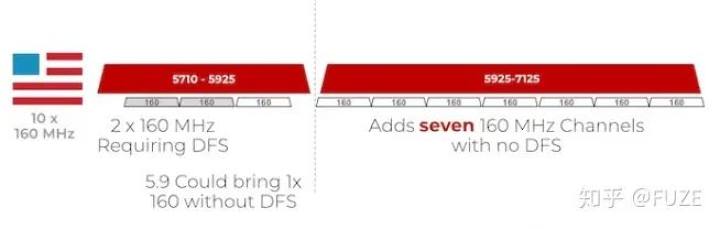
WiFi 7 6GHz frequency allocation (US standard)
4096-QAM Modulation Technology (√)
This is what some bloggers call "4K modulation technology," which means that a single carrier carries 12 bits of information, which is a 20% speed improvement compared to Wi-Fi 6's 1024-QAM 10 bits. It can be analogized to MLC (Second-Tier Storage Unit) and TLC (3-bit Multi-Cell Storage) on an SSD. The SSD's lifespan and reliability decrease from MLC to TLC, so everything has two sides. Although the "4096-QAM" information carrying capacity increases, it will also lead to a decline in anti-jamming capability.
Multi-Link Mechanism (Half √)
WiFi 7 can connect to three WiFi bands (6GHz, 5GHz, and 2.4GHz), and can simultaneously connect to two of these bands (5GHz, 6GHz) to transmit data in parallel, doubling bandwidth. It also allows two connections to verify data against each other for super stability!
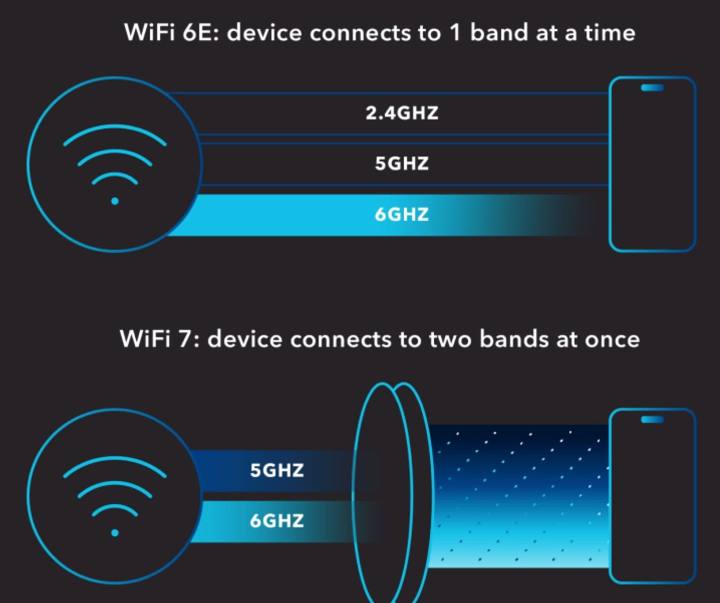
Schematic diagram of multi-link aggregation principle
Multi-RU Mechanism - Multiple Resource Unit (√)
In Wi-Fi 6, each user can only send or receive frames on a specific RU allocated, greatly limiting the flexibility of spectrum resource scheduling. To address this issue and further improve spectrum efficiency, Wi-Fi 7 defines a mechanism that allows multiple RUs to be allocated to a single user. This can be understood as allocating previously idle resources to users to improve transmission efficiency and avoid waste of electromagnetic wave resources.
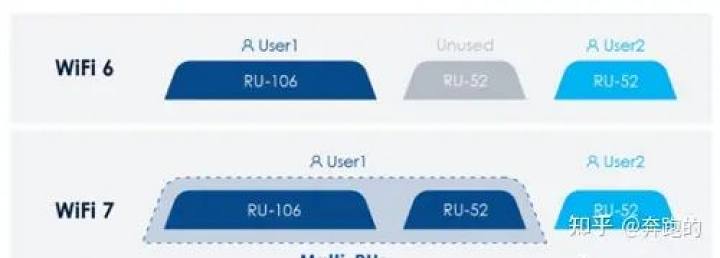
Schematic diagram of MRU principle
Supports up to 16 spatial streams (√)
Spatial streams can be simply understood as the number of antennas; with 16 spatial streams, a maximum speed of 48Gbps can be achieved. Currently, both mobile phones and laptops use 2x2 transceiver antennas, which ordinary users are not the target group for this feature.
Collaborative scheduling among multiple APs (individual users have limited perception)
Collaborative scheduling among multiple APs in Wi-Fi 7, including coordinated planning between cell domains in time and frequency domains, interference coordination between cells, and distributed MIMO can effectively reduce interference between APs and greatly improve the utilization of air interface resources
Lead Frame Punching (√)
Personally, I think this is the most useful technology in WiFi 7. In Wi-Fi 6, if a channel encounters interference from other networks, the entire channel will be deactivated. Through preamble perforation, if interference does not occupy the entire channel, WiFi can now split part of the channel to transmit data. That is, WiFi 7 allows you to "block one lane" instead of closing the entire road.
When using WiFi-6, sometimes the air port speed is 2400m, and sometimes it's about 1200m in front of the router, mainly because channel interference causes some channels to be abandoned.
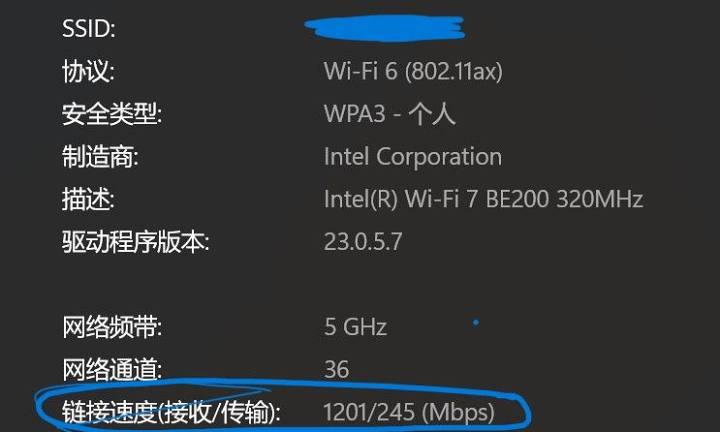
In Wi-Fi 6, speed drops due to channel interference
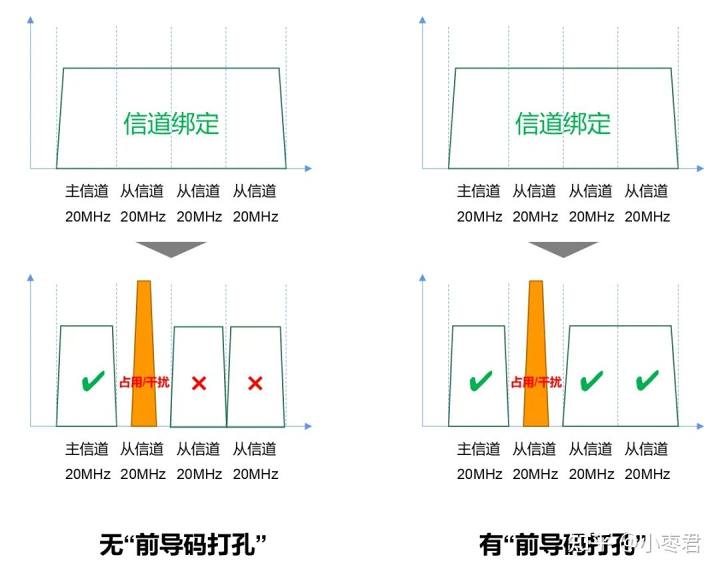
Pre-coder punching principle schematic diagram See watermark for source
2. Interpretation of the current impact of new WIFI7 technology on experience—make your own judgment about things
(1) 6GHz and 320MHz are not available
Currently, the country is unavailable, and the future prospects are bleak.
In July 2023, the Ministry of Industry and Information Technology issued the new "Regulations on Radio Frequency Classification of the People's Republic of China," which clearly states that all or part of the 6GHz (6425-7125MHz) frequency band will be used for 5G/6G systems. Therefore, 6GHZ is not impossible for WiFi but is almost zero (sad).
(2) Lowered barriers to experience with 4096-QAM
In the WiFi 6 era, some phones and routers with Qualcomm chips already implemented this feature, which is a high-end technology that has been extended to the general standard. This results in about a 20% increase in speed.
(3) Multi-link technology is "disabled" and has a high threshold for use
It looks beautiful, but due to the lack of 6GHZ, 60% of his martial arts are ruined.
Currently, the ideal scenario is for 5.2G and 5.8G bands to form a link aggregation. Speeds can reach up to 1.6Gbps.
There's another serious issue: based on my own and user tests, even if the WIN11 router supports and uses the latest BE200 network card, this feature can't be enabled. Microsoft plans to address this issue in Windows 11 24H2 (an update expected in the second half of 2024, another big deal).
Microsoft is guilty of heinous crimes, and users are full of complaints!
On the phone side, only Qualcomm Snapdragon 8 Gen 2 and later models support this feature, and manufacturers need strong software adaptation capabilities. So far, only the Xiaomi 14 series and Redmi K70 Pro have successfully enabled it.
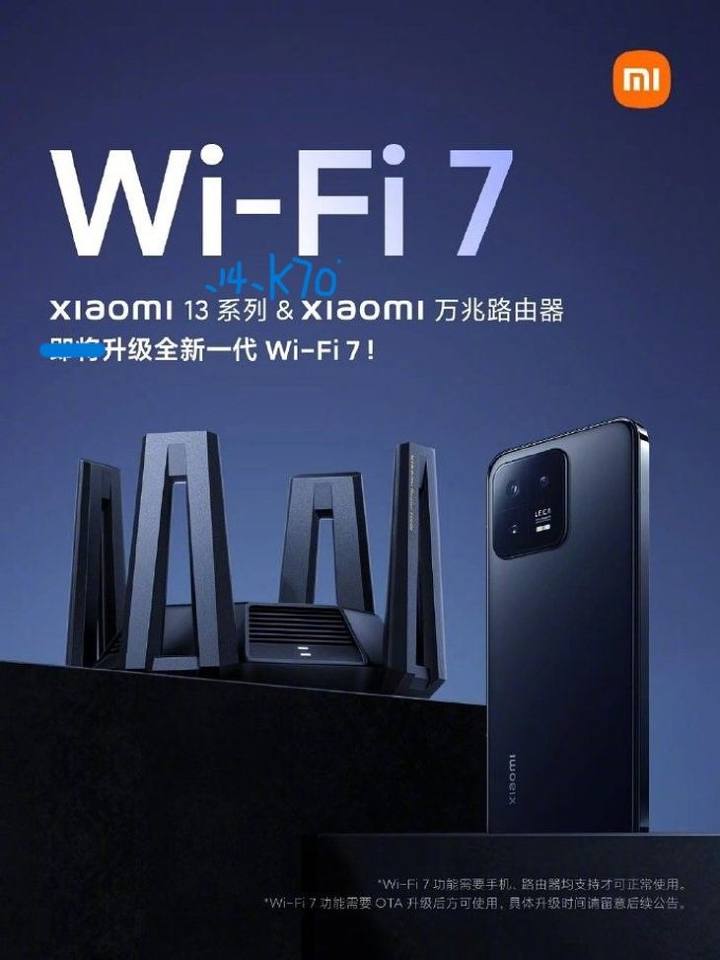
Xiaomi devices are at the forefront in supporting WIFI7 features
(4) Multi-AP collaboration and 16 spatial streams support relatively few target users
These two technologies are not aimed at ordinary individual users, so they can be considered to have weak perception.
Summary:
At this stage, WIFI7 is more like a martial arts master whose martial arts skills have been ruined. I am willing to call him the "Dark Archmage with Sealed Hands and Feet," able to unleash tremendous energy only when the seal is broken.
"Hurry up and get on WiFi 7, I'm really enjoying it!" "Unnecessary power consumption, weak perception," and "WiFi 6 is more than enough"—these views all seem valid, but they all fall into the limitations of seeing things from their own perspective.
Therefore, when looking at problems, one must "know what is true and understand the reasons behind it," and make your own judgments based on basic facts. This time, this is the key to staying rational in this fast-paced IT digital world.
Personal advice:
(1) Ordinary users who have a good WiFi 6 router can continue using it; there is no need to consider upgrading to WiFi 7 for now.
(2) If you are still using WiFi 5 or even WiFi 4, you can flexibly choose a high-end WiFi 6 router based on your budget (some Qualcomm chip routers for WiFi 6 can support WiFi 7 later) or a cost-effective WiFi 7 router. If you're already holding the MI14, once you use the iPhone 15, there's no need to stick with WiFi 4/5. The barrel's volume depends on the shortest section.
(3) Digital tech enthusiasts: Just go for it! With such excellent Future Warfare technology, aren't you tempted?!
Postscript:
The reason for this article is that I saw some forums flooded with Wi-Fi 7 router advertorials and "enough" users mocking Wi-Fi 7 buyers without reason. This kind of polarization really does seem to raise blood pressure. Thus, this short essay written in my spare time came to be. Hope this helps everyone!
To avoid discrepancies in the discussion, all reference information comes from router manufacturers' technical documents and IEEE standard public technical documentation.
? Original link:https://www.coolapk.com/…
![[Text and Image Summary] Summary of Terminals Currently Supporting 5G-A Carrier Aggregation --- Includes How to Check Carrier Aggregation Enabled on iOS - Baiyun Blog](https://www.bybk.cc/wp-content/uploads/2024/04/20240407140712630-e26ee861710dd3b075a1302dd00392d5e1db60a1.jpeg)



![[Open Source Reading] January 2024 ≈ 400 carefully edited book source compilation and update - Baiyun Blog](https://www.bybk.cc/wp-content/uploads/img/af867764c3780f0b7da88376fca7bf92.png)
![[Open Source Reading] November 950+ carefully proofread book source compilation and update - Baiyun Blog](https://www.bybk.cc/wp-content/uploads/2023/02/Screenshot_20230222-1001582-1024x593.png)
![[Open Source Reading] October 1300 Book Source Update - Baiyun Blog](https://www.bybk.cc/wp-content/uploads/img/1eeb6ae31cde88ab39faa2f19651638d.jpeg)
![[VMOS PRO 2.9.6 Member Edition] - Baiyun Blog](https://www.bybk.cc/wp-content/uploads/img/c303a7a50d3ebfa235cc380190db2980.png)




No comments yet