
Preface:
First of all, I want to thank my cool friends for their support during this time
Many cool friends have asked me a lot about lensesShoppingI've finally had some free time recently, so today I'll share with fellow cool friends how to choose lenses and advice on lens brands, and I'll try to express myself in the simplest and most understandable way. So I wrote this article hoping to encourage brothers who wear glasses!!
(The text and images are quite long, so it's recommended to bookmark and read.)

1. Knowledge related to lensesPopular science
Let's first talk about some knowledge about lenses, such as the mainstream lens materials, types, refractive index, Abbe number, spherical versus aspherical surfaces, and other related issues on the market.
(1) Lens material
Currently, there are three mainstream types of lenses (glass element, resin element, and cosmo element).
Glass shards
Advantages: Good light transmittance, durability, and long lifespan
Disadvantages: heavy and fragile, not suitable for rimless glasses, poor UV protection.
Resin sheets:
Advantages: medium light transmittance; mainstream glasses currently use resin sheets, which offer excellent UV protection
Disadvantages: Ages quickly; after two or three years, it tends to turn yellow.
Universe films:
Advantages: Durable, not broken
Disadvantage: Poor light transmittance.
(2) Types of lenses
There are many types of lenses on the market. Besides the single-vision lenses commonly worn by myopic people, there are also some more functional lenses, blue light protection lenses, anti-fatigue lenses, anti-fog lenses, and more.

We mainly talk about single-vision lenses, which are our mainstream ordinary lenses.
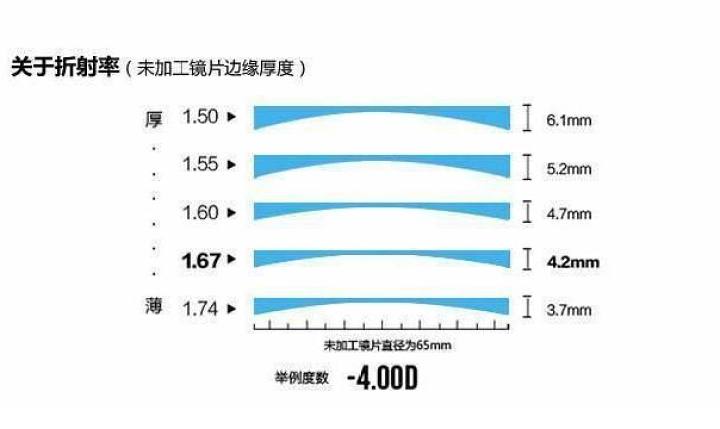
(3) Refractive index
This parameter is one of the important indicators when choosing lenses. Understanding it mainly allows us to know the thickness of the lens.
Mainstream common refractive indices: 1.56, 1.60, 1.67, 1.74
The higher the refractive index, the thinner the lens and the higher the price.
The lower the refractive index, the thicker the lens, and the lower the price.
(4) Abbe number
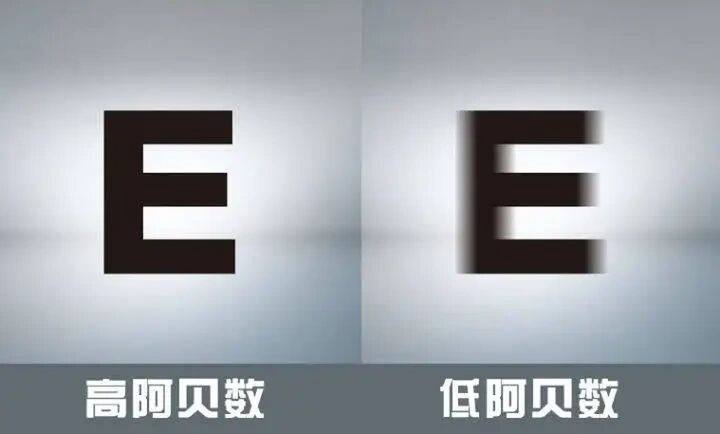
Currently, Abbe number is also one of the key indicators of lens optical performance, mainly reflecting the lens image quality.
Currently, this indicator is mostly a theoretical value for ordinary people; the human eye can perceive it very low, so we won't elaborate further here.
Moreover, mainstream brands with the same refractive index lenses generally have similar Abbe numbers, so there's no need to worry too much about this indicator.
5) Spherical and aspherical surfaces
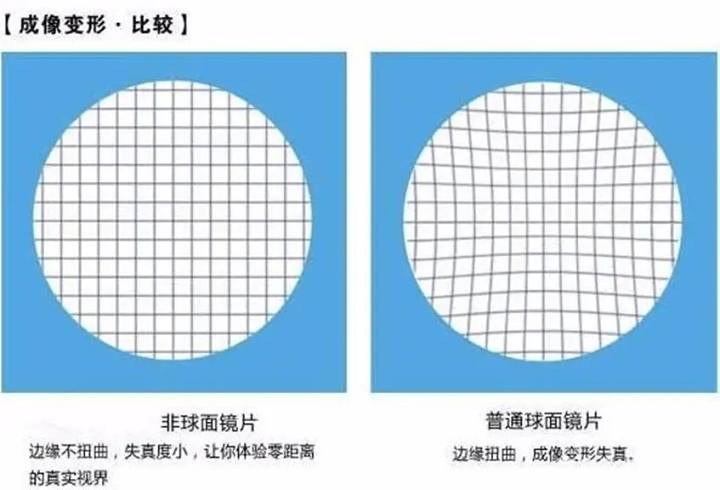
Currently, there are three types: spherical, aspherical, and double aspheric.

The advantages of aspheric lenses include significantly reduced edge aberration, less distortion around the lens, and a more natural and aesthetically pleasing eye area—these are the mainstream advantages today.
Spherical images are rarely seen now, as aberrations can change, leading to distorted peripheral vision and unstable image quality.
Double aspheric lenses can be achieved in only a few brands, but they are difficult to manufacture and usually expensive. Of course, all indicators are better than aspheric types, making them suitable for people with ultra-high myopia.
2. How to choose lenses that suit you
Based on my years of shopping experience, the most important things are to look at!!
Look at budget, alcohol consumption, and needs
You can refer to my previous article: first, you must check your own budget and act within your means—better to be the head of a chicken than the tail of a phoenix.
(1) Check the budget
Whatever your budget is, choose the brand you choose. There's really no need to force yourself into Zeiss or Essilor.Cost performanceGood options like Seete Nai and Kaimi are also great choices! Take it slow
(2) Check the prescription
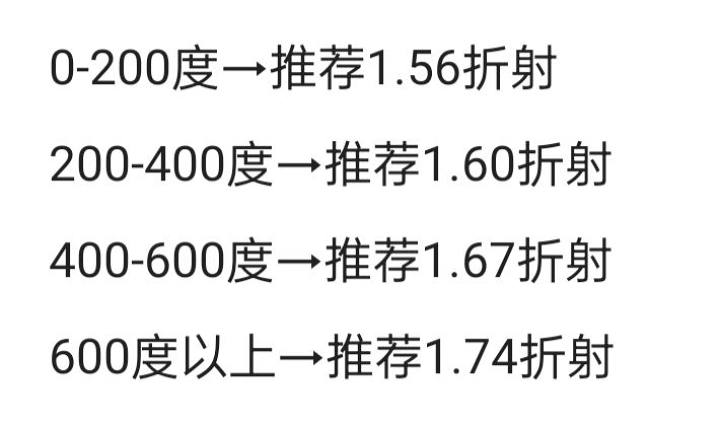
If the prescription is high, choosing a high refractive index (1.67 or 1.74) will also result in a higher price.
For lower prescriptions, choose low refractive index (1.56 to 1.60), which usually results in a cheaper price.
So many people wonder why the difference is so much higher than (1.74 yuan vs. 1.67), which involves a lot of issuesTechnologyThe difference is truly significant. (I'll explain this part in detail when I have time)
For power and refractive index, you can refer to the chart below
(3) Assess demand
Finally, consider whether you have other needs, such as blue light protection, fatigue resistance, or specialized lenses for driving, adding functional features.
Summary: Choose which brand of glasses based on your budget, and then choose the refractive index that suits you based on your prescription. Finally, check if you have any special needs
Brothers with steamed buns are a different story!!
3. Mainstream Lens Brand Recommendations (Zeiss, Essilor, Cami, Mingyue)
Currently, mainstream lens brands include Germany's Zeiss, France's Essilor, Korea's Kemi, Japan's HOYA, Seiko, Donghai, etc., and domestic brands like Mingyue.
Here, I won't talk about everyday life, only the mainstream
。 Here, we mainly recommend Zeiss, Essilor, Camie, and Mingyue.
Zeiss and Essilor are basically among the industry's top tier, while Cami has always had a good reputation, making it the king of value for money. Our domestic Mingyue is also quite reliable. There's another product I have to mention: Zeiss's Vision, which performs very well in all aspects of lens imaging [Leeuwenhoek][Leeuwenhoek].
1: Zeiss
—— Zeiss A Series ——
Entry-level lenses use domestic materials, basically domestic materials, moderate price, and use Zeiss lotus film with low hardness. Not highly recommended!
—— Zeiss Blue Light Blocking Lens——
It uses the Diamond Cube blue light blocking coating, which is suitable for long-term viewingComputerIt is more suitable for those with scientific curvature, and its visual effect is better than the A series
—— Zeiss New Clear Sharp ——
It adopts an aspherical design, featuring scientific curvature, a clear and attractive field of view, and uses diamond-cubed platinum coating on the coating, which offers high lens hardness and excellent imaging performance. (Similar to blue light protection: one adds blue light protection, the other increases lens hardness.)
—— Zeiss Zerui (Recommended)——
The Zeiss Zerui series is an upgraded version of the new Clear Sharp series, featuring a freeform design that comprehensively enhances the visual experience, offering a wider range of visual effects.
— Zeiss New 3D Bolui —
Specially designed according to Asian facial shapes, with the angle and prescription for wearing framesOptimizationThe design has been upgraded for a more comfortable fit.
——Driving Type——
Pupil photosensitive technology, plus aurora film, and precision molding technology to effectively reduce glare and lessen driving fatigue, offering highly cost-effective lenses.
—— Zeiss Zhen Rui Series ——
It uses Diamond Cube platinum film and blue light blocking film, making it a high-end custom model.
——Zhirui Series——
Added to suit usInternetLife's Smart Intelligence recognition technology includes slimness, fast response, pupil sensing, and other features. Additionally, the Smart Sharp series
——DigitalSeries—
Digital is just a function, designed for long-term viewingMobile phones, looking at tablets,NotebookThe results are relatively good. By lowering the prescription of near vision, the eyes can adjust less when looking close.
— Summary: Priority selection level: Zhirui personalized > Zhenrui > Zhirui Asia Edition> New 3D Borui > Zhirui > Zerui> New Qingrui = Blue Light Blocking > A series
If your budget allows, choose the Zhirui. If you drive a lot, you can opt for the driving model (which reduces glare). It's commonly used for phones/tablets,LaptopsIf you're considering digital devices, the A series is the least recommended. Even if your budget is low, you can consider Shotnai
2: Essilor
—— Diamond Crystal Membrane Cleaner ——
1. Price positioning: Essilor's entry-level lenses offer high cost performance and are suitable for budget-conscious buyers
2. Technical features: Improved wear resistance, featuring radiation protection, double-sided UV protection, anti-static, and dustproof functions, with an emphasis on easy cleaning. The lenses are also very clear.
—— Diamond Membrane Rock ——
1. Upgrade Attributes: This is an upgraded version of the Original Diamond Crystal A3.
2. Performance Advantages: The lenses have improved wear resistance, scratch performance, and easy cleaning, resulting in a longer service life and making them a cost-effective choice.
—— Diamond Crystal A4 Blue Light Blocking ——
1. Design Intent: Mainly aimed at modern users who use digital devices for extended periods.
2. Functional features: Equipped with selective blue light blocking to filter harmful blue light. However, the lens has a yellowish background color, which may affect color-sensitive users.
——Diamond Crystal Film Blocks Blue Light——
1. Product positioning: An upgraded version of the A4 blue light blocking lens.
2. Advantages: While maintaining good blue light protection, the base color is clearer and the wear-resistant is better, making it suitable for people with high blue light protection requirements.
—— Diamond Crystal Film Blocks Blue Light ——
1. Quality Grade: It can be said to be the pinnacle of Essilor's coatings, an upgraded version of the Membrane Royal.
2. Comprehensive Performance: Combining Essilor's best technologies and features, it not only excels in wear resistance and blue light protection, but also provides outstanding reflection reduction, making it ideal for consumers seeking high performance.
—— Ai Zan Quan Xi ——
1. Product Features:2024Newly launched, it targets the Zeiss Zerui series, offering a larger area of clarity and providing sharper and more precise vision.
2. Coating selection: There are two film layers available: Membrane Guard or Membrane Zhi.
—— Ai Zan ——
Lens type: Digital progressive lenses, suitable for people who use digital products for extended periods. This series is divided into protective, stress-relieving, and enhanced types based on age and eye needs.
——Full-Vision Color Change——
1. Brand Advantage: Once synonymous with photochromic lenses, leading technology in the field of photochromic lenses.
2. Price Features: Affordable prices for ready-made films, while custom prices are slightly higher.
— Wanli Road Progressive Lenses —
Suitable for: People over 40 years old with decreased eye accommodation.
3. Kaimi
Here, I'll only talk about the U2 and U6 series, and I don't recommend buying them because of the origin and the market is quite chaotic
——U2 Series——
It mainly features high-definition lenses and UV protection, offering good value for money. Its dust and water resistance is decent, easy to clean, dirt-resistant, and wear-resistant—all aspects are decent.
——U6 Series——
It blocks blue light and UV rays. The front surface uses lens material to block UV projection, while the back uses a UV anti-reflective film to reduce UV reflection. It offers great value for money. The U6's background color is relatively lighter than other domestic brands. If you want blue light protection but mind the base color, the U6 should be your first choice.
4. SeeTena
It's a sub-brand of Zeiss, with good clarity and anti-submarine capability. It's a product produced on the Zeiss production line, and its quality easily beats all domestic brands. For friends with a budget of just a few hundred meters, this is the right choice. Personally, I also recommend this one
——Ultra-smooth high-definition coating HMC+
Increased hardness, easy care, wear-resistant and non-slip, clear and comfortable, waterproof and oil-resistant
——Blue Light Protection Coating——
On top of HMC, an additional layer of blue light blocking film is added. The film is blue-purple in color. Not only does it ensure hardness and clarity, but it also blocks harmful blue light, and the base color is lighter than the U6. Definitely worth buying.
5. Bright Moon

Original link:https://www.coolapk.com/…
![[Open Source Reading] January 2024 ≈ 400 carefully edited book source compilation and update - Baiyun Blog](https://www.bybk.cc/wp-content/uploads/img/af867764c3780f0b7da88376fca7bf92.png)

![[Text and Image Summary] Summary of Terminals Currently Supporting 5G-A Carrier Aggregation --- Includes How to Check Carrier Aggregation Enabled on iOS - Baiyun Blog](https://www.bybk.cc/wp-content/uploads/2024/04/20240407140712630-e26ee861710dd3b075a1302dd00392d5e1db60a1.jpeg)


![[Open Source Reading] November 950+ carefully proofread book source compilation and update - Baiyun Blog](https://www.bybk.cc/wp-content/uploads/2023/02/Screenshot_20230222-1001582-1024x593.png)
![[Open Source Reading] October 1300 Book Source Update - Baiyun Blog](https://www.bybk.cc/wp-content/uploads/img/1eeb6ae31cde88ab39faa2f19651638d.jpeg)
![[VMOS PRO 2.9.6 Member Edition] - Baiyun Blog](https://www.bybk.cc/wp-content/uploads/img/c303a7a50d3ebfa235cc380190db2980.png)




No comments yet